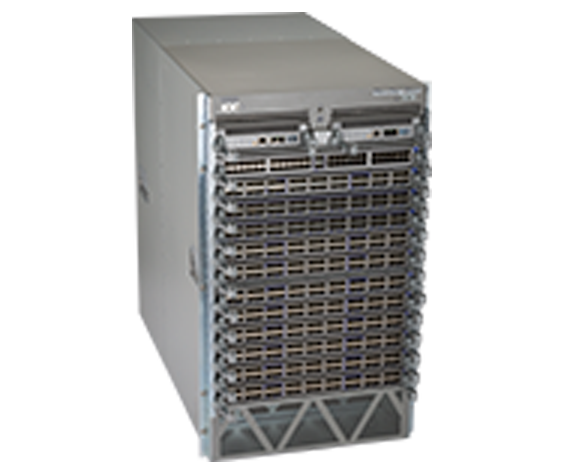


Designed for next-generation cloud environments, the Modular 400G Spine Switch delivers reliable and consistent data transmission at ultra-low latency.
Built with distributed packet processors and intelligent traffic handling, this spine switch provides unmatched reliability and efficiency.

With deep buffers and smart scheduling, your data center stays efficient.
Custom policies and telemetry for intelligent operations.
Save energy while achieving high throughput performance.
Supports integration across cloud, DCI, and service provider networks.
Works seamlessly with spine-leaf designs and hybrid cloud networks.
Powered by EOS, supporting automation and telemetry at scale.
Features MACsec, ACLs, and secure route filtering.
Low energy usage per port makes it sustainable for large-scale use.
Supports up to 288 400G ports for scalability.
Includes QoS, ACLs, and fair bandwidth allocation.
Real-time stats with LANZ and streaming telemetry.
Tailored for hybrid and public cloud infrastructure.
Netmate Information Technology delivers trusted expertise and tailored support to help your business stay secure, connected, and future-ready.
A Modular 400G Spine Switch is used in large-scale data centers and cloud environments to manage high-speed data traffic between network devices. It forms the backbone (or “spine”) of the network and ensures fast, scalable, and efficient data flow between servers, storage systems, and access switches.
Depending on the model and configuration, a Modular 400G Spine Switch can support up to 288 wire-speed 400G ports, making it ideal for high-density networking needs in cloud and enterprise infrastructures.
Yes, the Modular 400G Spine Switch is designed to support hybrid cloud deployments, offering compatibility with both private and public cloud systems. It enables seamless data movement and efficient routing between on-premises and cloud resources.
Absolutely. With a class-leading latency as low as 3.5 microseconds, it is well-suited for AI, ML, and real-time processing environments where minimal delay is critical to performance and accuracy.
The switch features hot-swappable components, redundant power supplies, and a self-healing operating system to reduce downtime. It also uses advanced monitoring tools to detect and resolve faults quickly, ensuring continuous and reliable network operations.