

Description
Arista 7500 Series Modular Core Switches
The Arista 7500 Series is a line of modular switches built for large data centers and enterprise networks. Each switch uses a chassis design, so you can add line cards and choose the speeds and ports you need. Depending on the generation, the series supports Ethernet speeds up to 100GbE or 400GbE.
Arista built the 7500 Series for data centers, cloud networks, enterprise cores, and service provider environments. It handles Layer 2 switching, Layer 3 routing, and network virtualization in compatible configurations. Arista EOS is the operating system. Deep buffers and Virtual Output Queues (VOQ) help the switch cope with heavy and uneven traffic.
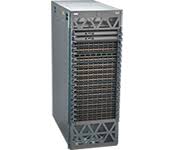
Key Features of the Arista 7500 Series
Modular Core Switching Architecture
The modular chassis lets you pick a platform that matches your port density and capacity needs. Chassis sizes range from mid-sized deployments to large data center environments. Compatible line cards give you room to choose interface speeds and port layouts.
High Switching Capacity
The series is built to carry large traffic volumes across data center and core networks. The 7500R family offers up to 150 Tbps of system capacity, and the 7500R3 reaches up to 230 Tbps. That capacity helps you connect many devices and support demanding workloads. Actual performance depends on the chassis and the line cards you install.
Deep-Buffer Switching and VOQ
Deep packet buffers absorb traffic bursts. VOQ keeps traffic headed for a congested port from blocking unrelated traffic. Networks that carry storage traffic, multicast streams, or other demanding workloads can benefit from this. Results depend on your traffic patterns and configuration.
Arista EOS
Arista EOS runs across compatible 7500 Series platforms. It supports switching, routing, configuration, and programmability. Network teams can use the same operating practices across supported Arista devices. Compatible management and automation tools also help with monitoring and troubleshooting.
Network Virtualization and Routing
The 7500 Series supports Layer 2 and Layer 3 networking for large data center designs. VXLAN and EVPN help build scalable virtual networks. ECMP spreads routed traffic across multiple paths, and MLAG supports redundant connections in suitable designs. Exact capabilities depend on the hardware model and EOS release.
High Availability and Network Monitoring
Supported chassis include redundant supervisors, fabric modules, power supplies, and cooling components. Hot-swappable hardware can make maintenance easier on supported configurations. CloudVision and LANZ add network management and congestion monitoring. Check feature and hardware compatibility before you deploy.
Capabilities of the Arista 7500 Series
The 7500 Series supports Layer 2 switching and Layer 3 routing for large data center networks. Teams can use compatible configurations for enterprise cores, cloud infrastructure, data center spine layers, and Internet peering. Its routing and virtualization features help you connect workloads, separate traffic, and grow your network in a planned way.
It also includes traffic management and monitoring features for demanding environments. Deep buffers and VOQ help control congestion, while ECMP distributes traffic across multiple paths. EOS supports programmability, and CloudVision and LANZ help with day-to-day operations. Available capabilities depend on the chassis, line cards, and software release.
Key Specifications
| Specification | Details |
| Product family | Arista 7500 Series |
| Product type | Modular core and data center switch |
| 7500R chassis models | 7504R, 7508R, 7512R, 7516R |
| 7500R3 chassis models | 7504R3, 7508R3, 7512R3 |
| Maximum system capacity | Up to 150 Tbps on 7500R; up to 230 Tbps on 7500R3 |
| Ethernet speeds | Up to 100GbE on 7500R; up to 400GbE on 7500R3 |
| Maximum 400GbE ports | Up to 288 on applicable 7500R3 configurations |
| Switching | Layer 2 and Layer 3 |
| Network virtualization | VXLAN and EVPN, depending on model and software |
| Operating system | Arista EOS |
| Buffer architecture | Deep packet buffers and VOQ |
| Hardware availability | Redundant components on supported configurations |
Common Use Cases
A large enterprise can use the 7500 Series as its core platform to connect business applications, storage systems, and data center networks. A cloud provider can place compatible models in the spine layer to move traffic between racks. Organizations running virtualized workloads can use VXLAN and EVPN to separate traffic across their infrastructure.
Service providers and Internet peering environments often need high-capacity switching and large routing tables. Data-heavy organizations may need deep buffers to handle traffic bursts between compute and storage systems. Colocation facilities can use modular chassis options to meet different connectivity needs. The right model depends on traffic volume, port density, network design, and expected growth.
Real-World Deployment Scenarios
- Data center spine: Connect many leaf switches over high-capacity links to carry traffic between server racks.
- Enterprise core upgrade: Replace an older core platform with a modular switch that fits your current bandwidth and port needs.
- Cloud infrastructure: Link virtualized workloads and infrastructure services across a scalable data center network.
- High-speed aggregation: Combine supported 100GbE or 400GbE connections using compatible chassis and line cards.
- Resilient connectivity: Pair supported hardware redundancy with diverse links and a suitable routing design to reduce single points of failure.
- Network expansion: Add compatible line cards, where supported, to increase port density as your needs grow.
Why Choose Netmate for the Arista 7500 Series?
Netmate IT provides IT infrastructure and networking solutions for businesses in the UAE and the wider region. Its Arista offerings can help you compare data center switching options by bandwidth, port density, network architecture, and future growth. Choosing a modular platform also means checking that it works with your existing servers, storage, cabling, and network equipment.
Netmate IT can talk through switch selection, network planning, and deployment requirements with you. Before you go ahead, confirm the model’s specifications, EOS compatibility, supported features, optics, and redundancy options. These checks help make sure the solution fits your network design and operations. Visit Netmate IT to learn more about its networking solutions.
Frequently Asked Questions
1. What is the Arista 7500 Series used for?
It is built for large data centers, enterprise core, cloud, and service provider networks. It offers modular, high-capacity switching for demanding traffic.
2. What is the difference between the Arista 7500R and 7500R3?
The 7500R family offers up to 150 Tbps of system capacity and interfaces up to 100GbE. The 7500R3 family reaches up to 230 Tbps and supports up to 400GbE on compatible configurations.
3. Does the Arista 7500 Series support 400GbE?
The 7500R3 family does, on compatible hardware and configurations. Check the specific model and line-card specifications before you plan a 400GbE deployment.
4. Does the Arista 7500 Series support VXLAN and EVPN?
Yes, on supported configurations. These features help with network virtualization and scalable data center designs. Availability depends on the hardware model and EOS release.
5. Can Netmate help businesses select an Arista 7500 model?
Yes. Netmate IT can discuss your networking requirements and the relevant Arista solutions. When choosing a model, consider capacity, port density, interface speeds, compatibility, redundancy, and future growth.

Reviews
There are no reviews yet.