

Description
Arista 7050X3 Series Data Center ToR Switches
The Arista 7050X3 Series brings high-speed Ethernet switching to modern data centers. These fixed-configuration switches are built for Top-of-Rack (ToR) use, where a switch connects the servers in a rack to the wider network. Depending on the model, the series supports Ethernet speeds from 10G to 100G.
Arista designed the 7050X3 Series for enterprise data centers, cloud infrastructure, and service provider networks that need to scale. The hardware handles Layer 2 and Layer 3 forwarding, and Arista EOS adds the operating and automation layer. It also supports VXLAN, MLAG, and ECMP, which help with segmentation, redundancy, and traffic distribution.
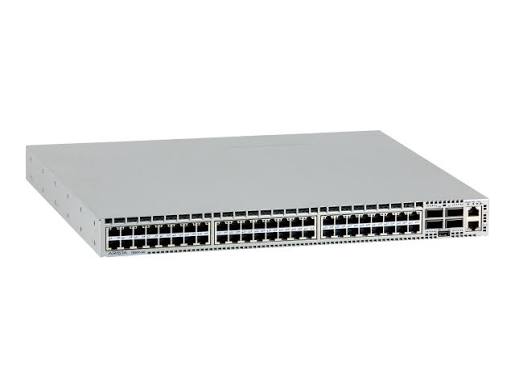
Key Features of Arista 7050X3 Series
High-Density Ethernet Connectivity
The series is available in a range of port configurations, so that you can match the switch to your data center’s needs. Some configurations pair 25G server ports with 100G uplinks. Others focus on 100G for high-bandwidth roles. This makes it simpler to plan your ToR layer around your server interfaces and uplink potential.
Low-Latency Switching
Fast server-to-server communication matters for lots of workloads. On applicable models, latency starts at 800 nanoseconds. Real performance relies on the switch you pick and your operating situations. Distributed applications, data processing, and other overall performance-sensitive workloads can benefit from this.
Arista EOS Operating System
Arista EOS runs the 7050X3 Series. It supports configuration, programmability, and automation throughout compatible Arista devices. Your team can follow the same configuration and management practices throughout the switching layer, which continues routine duties easily. Supported management integrations also help with monitoring and troubleshooting.
VXLAN and Network Virtualization
VXLAN helps you to amplify Layer 2 segments throughout a Layer three network. The series helps with appropriate designs, which include virtualized data centers. This facilitates separating workloads and constructing scalable overlays. Exact capabilities depend on the model and the EOS release.
High Availability and Redundancy
Applicable models offer redundant, hot-swappable power supplies and cooling components. This keeps hardware available and makes component replacement less complicated. For resilient designs, Arista additionally documents MLAG and ECMP. MLAG allows link aggregation across multiple devices, and ECMP spreads routed traffic over several paths.
Network Monitoring and Automation
CloudVision helps with network management and workflow automation. Zero Touch Provisioning (ZTP) can make first-time device setup simpler. LANZ gives you visibility into congestion and microbursts. Before you plan around any of these, test that your selected version and EOS release supports them.
Capabilities of Arista 7050X3 Series
The 7050X3 Series helps with Layer 2 switching and Layer 3 routing for data center networks. Your team can use supported VLANs, routing protocols, and VXLAN to connect workloads and segment traffic.
The switches also fit leaf-spine designs, where ECMP spreads routed traffic across more than one path. Depending on the version and setup, MLAG can provide redundant links between devices. EOS handles configuration and automation, and compatible monitoring tools assists you in observing traffic patterns and tracing congestion. Together, these capabilities help you build scalable networks for enterprise programs, cloud workloads, and high-bandwidth offerings.
Key Specifications of Arista 7050X3 Series
| Specification | Details |
| Product family | Arista 7050X3 Series |
| Product type | Fixed-configuration data center switch |
| Ethernet speeds | 10G, 25G, 40G, 50G, and 100G, model-dependent |
| Maximum switching throughput | Up to 6.4 Tbps on applicable models |
| Maximum forwarding rate | Up to 2 billion packets per second on applicable models |
| Latency | From 800 ns on applicable models |
| Switching | Layer 2 and Layer 3 |
| Network virtualization | VXLAN and EVPN capabilities, model and software-dependent |
| Operating system | Arista EOS |
| Network management | CLI and supported automation and monitoring tools |
| Power and cooling | Model-dependent redundant power supplies, hot-swappable fans, and airflow options |
| Rack configuration | Model-dependent, including 1RU and 2RU configurations |
Common Use Cases
A cloud service company dealing with growing customer workloads would possibly want better-bandwidth connections among its servers and network infrastructure. A company running virtualized applications should require a scalable switching layer to connect racks while keeping network segments separate. A financial services enterprise processing large volumes of transactions would possibly want low-latency connectivity between application servers and databases. A data-intensive organization running compute-intensive workloads should require high-speed links to move data among compute systems and storage.
A colocation facility hosting numerous clients would possibly want flexible port configurations to accommodate different server connectivity necessities. An enterprise upgrading its data center from 10G to 25G server connections may want to use a well-suited 7050X3 model with suitable uplinks to guide the transition. These situations are not unusual requirements: dependable, scalable, high-speed connectivity between data center systems, which the Arista 7050X3 Series can support while the chosen model suits the workload and network design.
Real-World Deployment Scenarios
- Enterprise server racks: Connect servers to 25G access ports and use supported 100G uplinks to link each rack to the broader network.
- Leaf-spine fabric: Use compatible switches as leaf or spine devices to create a scalable network with multiple forwarding paths.
- Virtualized infrastructure: Use supported VXLAN capabilities to connect virtualized workloads across network segments.
- Redundant connectivity: Apply appropriate MLAG and ECMP designs to create backup paths and stable traffic.
- Server network upgrades: Migrate compatible workloads from 10G to 25G where both the switch and server interfaces support it.
- Traffic monitoring: Use supported LANZ and management tools to spot congestion and inspect traffic in busy environments.
Why Choose Netmate for Arista 7050X3 Series?
Netmate IT plans and deploys Arista data center switching from its office in Bur Dubai. Network engineers help pick the appropriate 7050X3 models, configure EOS, install CloudVision, and design the leaf-spine layout across the customer’s existing servers, cabling, and storage. The intention is to hand over a network that is ready for production, not a box of switches and a datasheet. Whether the network operates easily or becomes a source of daily troubleshooting frequently depends on early design decisions, which include port density, 25G or 100G server connectivity, and uplink sizing.
Netmate’s work spans the UAE and, more broadly, across the GCC, Kenya, Nepal, and Africa, for IT teams that need a data center network constructed for actual traffic and real growth. Whether a customer desires assistance with switch selection and supply or desires complete support with design, setup, and ongoing operations, Netmate handles the planning and deployment in both ways. Before move-in, the team also confirms version-specific specifications, EOS compatibility, licensing, and integration requirements, so there are no surprises later.
Frequently Asked Questions
1. What is the Arista 7050X3 Series used for?
The Arista 7050X3 Series is built for data center switching. It connects servers and other network devices, and it really works nicely in leaf-spine architectures, cloud infrastructure, and corporate networks. Different models offer distinct port configurations, so that you can pick one that suits your deployment.
2. Does the Arista 7050X3 Series support 25G and 100G Ethernet?
Yes. Supported models offer 25G and 100G Ethernet. Port counts and interface combinations vary by model, so check the official datasheet before you choose a switch.
3. Can Arista 7050X3 switches be used in a leaf-spine architecture?
Yes. The series is designed for both leaf and spine roles. ECMP, MLAG, and VXLAN help teams build scalable and resilient network fabrics. The final design depends on the models you select and your network requirements.
4. Which operating system does the Arista 7050X3 Series use?
It runs Arista EOS, which handles switching and routing and also supports programmability, automation, and network management. Available features depend upon the hardware model and the software release you install.
5. Can Netmate help with Arista 7050X3 deployment?
Yes. Netmate IT provides Arista data center networking solutions. You can speak to the team about switch choice, network architecture, connectivity requirements, and deployment making plans. The appropriate configuration depends on your infrastructure and how you propose to use it.


Reviews
There are no reviews yet.