

Description
Dell PowerEdge T360 Tower Server
The Dell PowerEdge T360 Server is a single-socket tower server engineered for growing small-to-medium businesses, remote offices, branch office environments, and near-edge deployments. Designed in a versatile 4.5U standalone chassis, this server balances high-speed processing performance, flexible storage expansion, and enterprise-grade system management. It provides essential infrastructure capabilities without requiring a traditional data center rack deployment.
The platform integrates compute power driven by Intel Xeon processors alongside DDR5 memory architecture. This design enables organizations to run core business productivity software, handle data storage needs, process multi-user workloads, and maintain localized security controls across distributed business sites. Dell positions the PowerEdge T360 as an efficient compute solution for everyday operations.
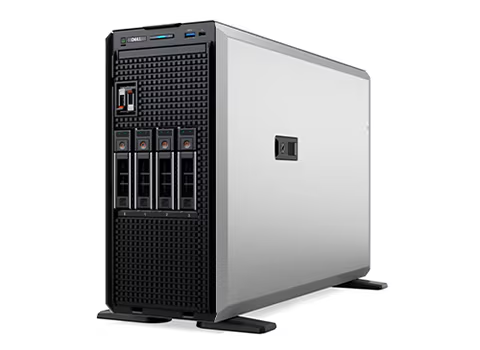
Key Features of Dell PowerEdge T360 Server
Advanced Compute and Memory Architecture
The PowerEdge T360 utilizes the Intel Xeon E-2400 series processor architecture. Single-socket execution delivers core capacity for multi-threaded business applications. Accompanied by DDR5 memory with Error-Correcting Code (ECC), the system increases data transmission speeds and memory bandwidth over previous generations while automatically mitigating single-bit memory errors.
Versatile Storage and RAID Capabilities
Storage configurations offer flexible scaling to accommodate growing organizational data requirements. The system supports 3.5-inch and 2.5-inch SAS or SATA HDDs and SSDs. Hardware RAID controllers, such as the PERC H355 and PERC H755, deliver data redundancy, performance tiering, and protection against disk failures. The BOSS-N1 storage subsystem isolates system boot drives onto redundant M.2 NVMe SSDs.
High-Speed I/O and PCIe Gen5 Connectivity
The server motherboard incorporates modern I/O bandwidth through PCIe Gen5 expansion. Equipped with up to four PCIe slots, the system accommodates optional high-throughput network interface cards (NICs), host bus adapters (HBAs), and single-width graphics acceleration modules. Integrated Broadcom dual-port Gigabit Ethernet ports establish standard local network connectivity.
Integrated System Security and Resilience
Dell equips the PowerEdge T360 with security protections built into the silicon level. Features like Silicon Root of Trust, Secure Boot, Cryptographically Signed Firmware, and System Lockdown safeguard system hardware and firmware against unauthorized changes. Optional Trusted Platform Module 2.0 (TPM 2.0) and Self-Encrypting Drives (SED) provide hardware encryption for sensitive stored data.
Remote Lifecycle Management with iDRAC9
System administrators can remotely configure, deploy, monitor, and update the PowerEdge T360 using the Integrated Dell Remote Access Controller (iDRAC9). Operating independently of the host OS, iDRAC9 provides full out-of-band management via a dedicated Ethernet port. This reduces the need for on-site administrative staff at branch or edge locations.
Capabilities
- Compute execution: Handles multi-threaded daily office processing, software runtime services, and localized enterprise database tasks.
- Data storage management: Supports hybrid or high-capacity SAS and SATA array configurations up to 128 TB total storage.
- System virtualisation: Provides memory bandwidth and CPU resources to host entry-level virtual machine environments under VMware or Hyper-V.
- Data security: Built-in security architecture prevents unauthorized firmware alterations and protects stored assets.
- Thermal and power efficiency: Automated air cooling and high-efficiency redundant PSUs maintain system stability in non-dedicated server rooms.
- Remote operation: Enables centralized management, diagnostic monitoring, and firmware deployments across remote branches via iDRAC9.
Key Specifications
| Feature / Specification | Details |
| Series | Dell PowerEdge Tower Series |
| Model | PowerEdge T360 |
| Form Factor | 4.5U Tower Chassis |
| Processor | 1 × Intel Xeon E-2400 Series (up to 8 cores) or Intel Pentium G7400/G7400T |
| Memory | Up to 128 GB (4 x DDR5 ECC UDIMM slots, up to 4400 MT/s) |
| Storage Bays | Up to 4 x 3.5″ SATA or up to 8 x 3.5″/2.5″ SAS/SATA HDD/SSD |
| Boot Storage | Optional BOSS-N1 (2 x M.2 NVMe HWRAID) |
| RAID Controllers | PERC S160 (Software), PERC H355, PERC H755, HBA355i |
| Network Interfaces | 2 × 1GbE LOM (Broadcom 5720) |
| Management Port | 1 × Dedicated iDRAC Ethernet Port |
| Expansion Slots | 1 × PCIe Gen5 x16, 3 × PCIe Gen4 |
| USB Ports | Front: 1 × USB 3.2 Gen1, 1 × iDRAC Direct (Micro-AB USB); Rear: 3 × USB 3.2 Gen1, 3 × USB 2.0 |
| Power Supply | 450W Cabled Platinum, or 600W/700W Redundant Hot-Plug (Platinum/Titanium) |
Common Use Cases
The Dell PowerEdge T360 Tower Server fits decentralized infrastructure environments that require compute performance, local storage, and remote accessibility without dedicated server racks. Organizations can deploy it in branch offices, retail outlets, educational institutions, and mid-sized office environments. The server handles productivity services, local directory databases, file systems, and localized edge workloads. Specific deployments vary based on CPU selection, drive configurations, RAM allocations, and operating environment requirements.
Real-World Deployment Scenarios
- File and Print Serving: Houses centralized business files, shared media folders, and print queues for local office network users.
- Branch Office All-in-One: Runs domain controllers, file management, active directory, and local backup tasks inside a single chassis.
- Web Hosting and Email Services: Hosts internal web portals, customer-facing intranet sites, and dedicated business email platforms.
- Light Virtualisation Host: Runs lightweight virtual machines using VMware or Microsoft Hyper-V for isolated application testing and server consolidation.
- Small Business Database Server: Processes transactional databases, inventory management software, and accounting platforms.
- Near Edge Processing: Handles localized video analysis, IoT data aggregation, and point-of-sale processing at retail or industrial sites.
Why Choose Netmate for Dell PowerEdge T360?
Netmate IT helps organizations in Nepal evaluate and deploy Dell PowerEdge server configurations based on compute, storage, and operational requirements. For the PowerEdge T360, Netmate assists teams in selecting the right processor tiers, memory capacity, RAID controllers, and drive configurations. Netmate manages physical hardware setup, operating system deployment, iDRAC remote management integration, and post-installation technical support. The goal is to deliver a reliable server setup aligned with business budgets and growth expectations.
Frequently Asked Questions
What is the Dell PowerEdge T360 Server?
The Dell PowerEdge T360 is a single-socket 4.5U tower server powered by Intel Xeon E-2400 series processors. It provides scalable DDR5 memory, flexible SAS/SATA storage configurations, and integrated iDRAC9 management for small-to-medium businesses and remote offices.
What is the maximum RAM supported by the PowerEdge T360?
The PowerEdge T360 supports up to 128 GB of DDR5 ECC UDIMM memory across 4 DIMM slots, operating at speeds up to 4400 MT/s.
What storage configurations are available on the T360?
The T360 offers multiple drive bay chassis configurations, supporting up to 4 x 3.5-inch SATA drives or up to 8 x 3.5-inch/2.5-inch SAS/SATA HDDs/SSDs. It also supports an optional BOSS-N1 card with dual M.2 NVMe SSDs for hardware-boot redundancy.
What expansion slots are provided on the Dell PowerEdge T360?
The server features up to four PCIe expansion slots: 1 x PCIe Gen5 x16 slot for high-bandwidth add-in cards and 3 x PCIe Gen4 slots for additional network adapters or RAID controllers.
Who should use the Dell PowerEdge T360 Server?
The platform is designed for small-to-medium businesses, branch offices, retail stores, and edge sites needing single-socket performance for file serving, light virtualization, business databases, and remote administration
Reviews
There are no reviews yet.