

Description
PowerEdge XE9780L
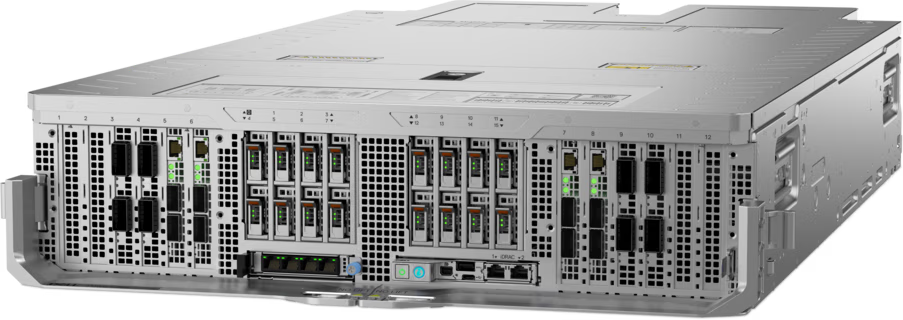
The PowerEdge XE9780L is a high-density, liquid-cooled AI server engineered by Dell Technologies for enterprise organizations demanding extreme computational performance, massive throughput, and scalable deep learning infrastructure. Built in a compact 3 OU (Open Rack Unit) form factor designed for Dell’s Integrated Rack (IR7000 series) environments, this platform supports demanding artificial intelligence, machine learning, and high-performance computing (HPC) workloads. It delivers dedicated computational pipelines for large language model (LLM) training, real-time inferencing, and complex simulation tasks.
The platform integrates dual Intel Xeon 6 processors with custom-built Direct Liquid Cooling (DLC) infrastructure and NVIDIA HGX GPU acceleration. This hardware architecture enables data centers to process high-volume tensor workloads, execute massive concurrent matrix operations, and offload computational bottlenecks from traditional air-cooled server nodes. Dell positions the PowerEdge XE9780L as a flagship solution for rack-scale AI density and thermal efficiency.
Key Features of PowerEdge XE9780L
Direct Liquid Cooling Architecture
Heavy AI training and generative model execution draw significant electrical power and generate high thermal loads. The PowerEdge XE9780L replaces conventional air heatsinks with a direct liquid cooling (DLC) loop connecting CPUs, GPUs, and NVLink switches. DLC maintains thermal stability under continuous max-TDP conditions, preventing thermal throttling and reducing global data center power usage effectiveness (PUE) metrics.
Next-Gen NVIDIA GPU Acceleration
Equipped with an eight-way NVIDIA HGX accelerator board, the server supports maximum-density matrix math operations. Using NVIDIA NVLink technology, the GPUs communicate over a high-bandwidth mesh, allowing huge neural network parameter sets to stay synchronized across all eight accelerators without hitting standard PCIe bus bottlenecks.
Intel Xeon 6 Compute Engine
The dual-socket architecture hosts Intel Xeon 6 P-core processors. These processors handle data preprocessing, batch tokenization, and pipeline scheduling before pushing tensor data to the GPU matrix. High core counts and native PCIe Gen5 capability keep host-to-device IO channels operating at peak bandwidth.
High-Speed Expansion and Network Fabrics
The XE9780L provides up to four PCIe Gen5 x16 full-height, half-length expansion slots along with an OCP 3.0 SFF slot. This layout enables low-latency InfiniBand or 400GbE network interface cards (NICs), allowing cluster architectures to scale horizontally into massive multi-node AI supercomputing fabrics.
Integrated System Management
Dell’s embedded iDRAC10 controller allows local and remote administrative teams to monitor operational status, thermal profiles, power metrics, and component logs. Management interface options include dedicated RJ45 iDRAC ports, iDRAC Direct, RESTful APIs with Redfish support, and RACADM command-line tools.
Capabilities
- AI Model Training: Trains multi-billion parameter neural networks, generative vision models, and large language models across integrated GPU arrays.
- High-Throughput Inference: Runs low-latency AI inference workloads, batch scoring pipelines, and real-time processing applications.
- Extreme Memory Bandwidth: Combines high-speed DDR5 system memory and high-capacity GPU HBM3e memory to eliminate data transfer bottlenecks.
- Rack-Scale Density: Maximizes compute power within Open Rack V3 structures, enabling data centers to pack high numbers of GPUs into smaller physical footprints.
- Thermal & Power Optimization: Reduces power overhead via direct liquid cooling and efficient 33 kW rack powershelf power distribution architectures.
- Resilient Infrastructure Management: Employs iDRAC10, hardware root of trust, and signed firmware for remote monitoring, security, and fleet deployment.
Key Specifications
| Feature / Specification | Details |
| Series | Dell PowerEdge XE Series |
| Form Factor | 3 OU compute node (for IR7044 / IR7050 Open Racks) |
| Processor | 2 × Intel Xeon 6 Processors (Up to 128 cores per socket) |
| Accelerators | 8 × NVIDIA HGX B300 (270 GB) or 8 × HGX B200 (180 GB) SXM6 |
| Interconnect | NVIDIA NVLink across all 8 GPUs |
| Memory | Up to 32 DDR5 RDIMM slots (Up to 6400 MT/s) |
| Storage Bays | Up to 16 × E1.S Gen5 NVMe SSDs (Up to 122.88 TB raw) |
| Boot Controller | Boot Optimized Storage Subsystem (BOSS-N1, 2 × M.2 NVMe RAID 0/1) |
| Cooling | Direct Liquid Cooling (CPUs, GPUs, and NVSwitch) + Auxiliary Fans |
| Expansion Slots | Up to 4 × PCIe Gen5 x16 FHHL + 1 × OCP 3.0 Gen5 x16 slot |
| Management Ports | 2 × 1 GbE RJ45 dedicated iDRAC Ethernet ports |
| Rack Power System | Integrated IR7000 Powershelf (33 kW AC system options) |
Common Use Cases
The PowerEdge XE9780L server suits enterprise environments that require ultra-dense AI compute, high-throughput network fabric integrations, and liquid-cooled data center architectures. Organizations deploy it in modern data centers to run machine learning pipelines, deep learning model fine-tuning, large-scale simulations, and automated business platforms. It also integrates into high-performance computing clusters alongside high-speed NVMe storage systems. Specific configurations depend on thermal infrastructure, power shelf capacities, network switches, and application software stacks.
Real-World Deployment Scenarios
- Large Language Model (LLM) Fine-Tuning: Accelerate specialized model adjustments and pre-training across multi-GPU nodes with high HBM3e capacity.
- Generative AI Platforms: Process image, video, and text generation queries using parallel tensor computation pipelines.
- Autonomous Systems & Robotics: Execute training loops on large synthetic datasets to refine spatial and sensory AI models.
- Financial Modeling & Risk Analysis: Run high-speed quantitative simulations and real-time fraud detection algorithms across massive in-memory datasets.
- High-Performance Scientific Research: Perform molecular dynamics, physics simulations, and genomic sequencing computations.
- Enterprise AI Clusters: Connect liquid-cooled XE9780L nodes via InfiniBand/RoCE fabrics to form rack-scale supercomputing clusters.
Why Choose Netmate IT for PowerEdge XE9780L?
Netmate IT assists enterprise clients in evaluating, planning, and deploying high-performance Dell server solutions tailored to advanced compute, storage, and thermal requirements. For the PowerEdge XE9780L, Netmate supports IT teams through liquid cooling compatibility assessments, rack-scale power planning, network fabric design, and hardware integration. The goal is to deliver a reliable, enterprise-ready infrastructure solution aligned with performance expectations, security standards, and future expansion needs.
Frequently Asked Questions
What is the PowerEdge XE9780L?
The PowerEdge XE9780L is a 3 OU direct liquid-cooled AI compute node engineered by Dell Technologies. It holds dual Intel Xeon 6 processors and eight NVIDIA HGX SXM6 GPUs for high-density artificial intelligence and HPC applications.
What is the difference between the XE9780 and XE9780L?
The standard PowerEdge XE9780 uses a 10U air-cooled rack chassis, whereas the XE9780L is a 3 OU liquid-cooled compute sled built specifically for Open Rack V3 enclosures (such as Dell IR7000 racks). The liquid-cooled XE9780L enables significantly higher compute density per rack.
What GPUs are supported on the PowerEdge XE9780L?
The XE9780L supports eight-way NVIDIA HGX GPU baseboards featuring either NVIDIA HGX B300 (270 GB) or NVIDIA HGX B200 (180 GB) accelerators fully interconnected via NVLink.
What thermal management system does the XE9780L use?
The system utilizes Direct Liquid Cooling (DLC) cold plates covering the CPUs, GPUs, and NVSwitch interconnects, connected to in-rack or in-row Coolant Distribution Units (CDUs), along with auxiliary gold high-performance fans for auxiliary component cooling.
Reviews
There are no reviews yet.