

Description
PowerEdge XR4520c
The PowerEdge XR4520c is a Dell edge-optimized compute sled designed for organizations that need high-density processing, rugged reliability, and scalable compute services at the edge. The collection includes flexible deployment options in short-depth 2U chassis designs (such as the XR4000r and XR4000z). It supports demanding localized edge workloads while providing dedicated interfaces for network management, high-speed telemetry, serial console, and expansion modules.
The platform combines Dell PowerEdge engineering with Intel Xeon D processing. This design allows companies to process edge AI workloads, manage virtualization and vSAN deployments, and offload computational tasks from core data centers. Dell positions the XR4520c sled for short-depth server performance and ruggedized edge deployment.
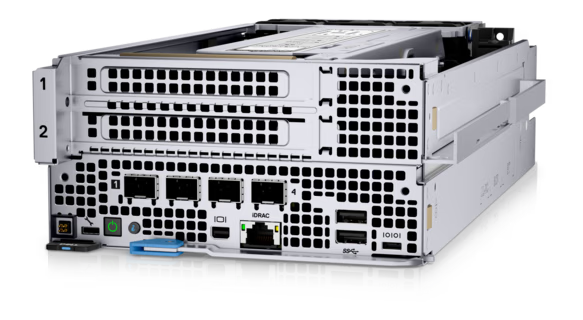
Key Features of PowerEdge XR4520c
Compute and Graphics Processing
The PowerEdge XR4520c processes workloads using single-socket Intel Xeon D processors with up to 20 cores. Standard compute processing specializes in enterprise virtualization and edge applications. Dual PCIe Gen4 x16 slots enable support for up to 250W GPU configurations, allowing edge decisions based on local AI and computer vision data.
High-Density NVMe Storage Offloading
Storage throughput can bottleneck localized compute systems. PowerEdge XR4520c sleds can offload fast storage tasks to up to 12 x M.2 NVMe SSDs (via add-in card and riser module). This can reduce physical footprint demands and help manage intensive local data logging and telemetry efficiently.
Flexible High-Speed Network Connectivity
The platform provides multi-gigabit interface options including 4 x 10GbE SFP or 4 x 25GbE SFP configurations. It also consists of a dedicated 10/100/1000Base-T iDRAC management port. This combination allows groups to attach the sled to different network topographies across distributed sites.
Edge High Availability and Ruggedization
The equipment supports configurations where multi-node XR4000 chassis compute sleds work together for application availability and operational continuity. The platform also helps with thermal operation in harsh conditions ranging from -5°C to 55°C, featuring MIL-STD-810H and NEBS Level 3 compliance.
Front-Accessible System Management
The XR4520c consists of front-accessible network ports, status LEDs, and a micro-USB iDRAC Direct connection. Administrators can use integrated iDRAC9 tools to view system diagnostics, perform telemetry monitoring, and execute remote management tasks without rear access.
Capabilities
- Application delivery: The platform manages edge workloads among remote sites and core infrastructure. It can help process sensor data streams and control localized compute tasks.
- Workload control: XR4520c can process compute tasks at scale using Intel Xeon D processors and optional GPUs. This allows administrators to deploy applications based entirely on edge intelligence and machine learning models.
- NVMe data processing: M.2 NVMe storage arrays enable managing high-speed local data logging without setting processing delays on remote cloud networks.
- Edge application availability: Organizations can use multi-node chassis configurations and BOSS-N1 boot resilience to build fault-tolerant edge execution environments.
- Performance optimization: Dell’s XR series platform makes use of short-depth and high-density thermal optimizations to improve localized compute processing in harsh environments.
- Centralized management: PowerEdge uses iDRAC9 and OpenManage integrations to offer control and management across distributed edge nodes.
Key Specifications
| Feature / Specification | Details |
| Series | PowerEdge XR4000 Series |
| Models | XR4520c Compute Sled |
| Form Factor | 2U single-width server sled |
| Processor | 1 × 3rd Gen Intel Xeon D Scalable processor (up to 20 cores) |
| Memory | Up to 512 GB DDR4 (4 x DIMM slots, max 2933 MT/s) |
| Storage | Up to 12 × M.2 NVMe SSDs (8 on PCIe card, 4 on riser module) |
| High-Speed Network Options | 4 × 10GbE SFP or 4 × 25GbE SFP |
| Management Port | 1 × 1GbE RJ45 (iDRAC9 dedicated) |
| Console / Direct Port | 1 × Serial port, 1 x Micro-AB USB (iDRAC Direct) |
| Display Interface | 1 × Mini-DisplayPort |
| USB Ports | 2 × USB 3.0 (Front), 1 x USB 3.0 (Internal optional) |
| PCIe Expansion | 2 × PCIe Gen4 x16 full-height, full-length slots |
| GPU Support | Up to 2 × 150W single-width or 1 × 250W double-width GPU |
Common Use Cases
The PowerEdge XR4520c fits edge computing environments that need controlled node density, server availability, and efficient handling of local data processing. Organizations can use it in telecom sites, military units, industrial floors, retail sites, and remote branch facilities to run edge AI, video surveillance, and virtualized workloads. It can also handle NVMe storage pooling and integrate with existing 10GbE and 25GbE network infrastructure. The precise deployment depends on workload intensity, expansion cards, environmental conditions, and required software stacks.
Real-World Deployment Scenarios
- Edge Artificial Intelligence: Run real-time machine learning models and inferencing workloads on local video or sensor feeds using dedicated GPUs.
- Telecom and 5G Infrastructure: Process network functions and edge workloads in space-constrained cell towers and central offices under NEBS Level 3 conditions.
- Retail and Point-of-Sale Systems: Manage store infrastructure and analytics locally across multiple store locations with remote iDRAC administration.
- Industrial Automation Environments: Place compute nodes directly on factory floors to analyze telemetry and control automated manufacturing lines.
- Video Surveillance & Machine Vision: Aggregate camera feeds, store high-resolution footage locally on NVMe arrays, and run automated surveillance analytics.
- Hyperconverged Edge Infrastructure (vSAN): Combine multi-node sleds in an XR4000 chassis to deliver resilient virtual machines at distributed sites.
Why Choose Netmate for PowerEdge XR4520c?
Netmate IT helps agencies in Nepal compare and deploy Dell PowerEdge solutions based on their compute, environmental, and network requirements. For the PowerEdge XR4520c, Netmate can assist groups in selecting the appropriate sled configuration, planning the chassis deployment, integrating the sled with current network hardware, and configuring required server management features. The aim is to offer a practical Dell compute solution that suits the enterprise’s performance, durability, density, and infrastructure requirements.
Frequently Asked Questions
What is the PowerEdge XR4520c?
The PowerEdge XR4520c is a Dell short-depth compute sled designed for edge processing and compact multi-node deployments. It fits into XR4000 series chassis (XR4000r and XR4000z) and provides 10GbE/25GbE networking options along with PCIe expansion.
What is the difference between single-width and double-width XR4000 sleds?
Single-width sleds (like the XR4510c) focus on compact compute and standard expansion, whereas double-width sleds like the XR4520c offer extended PCIe capability to host larger GPUs up to 250W or additional expansion cards.
How much memory and storage does the PowerEdge XR4520c support?
The XR4520c supports up to 512 GB DDR4 LRDIMM memory across 4 slots. For storage, it supports up to 12 x M.2 NVMe SSDs along with dedicated BOSS-N1 dual M.2 boot storage.
What network interfaces does the PowerEdge XR4520c have?
The platform offers modular network I/O options including 4 x 10GbE SFP or 4 x 25GbE SFP configurations. It also features a 1GbE iDRAC RJ45 management port, micro-USB iDRAC Direct port, serial console, and USB 3.0 ports.
Who should use the PowerEdge XR4520c?
The platform fits organizations that need high-density, rugged hardware for edge computing, virtualization, AI inferencing, and remote site management. It suits industrial sites, telecom deployments, and edge environments that require a short-depth system built for harsh temperatures.
Reviews
There are no reviews yet.