

Description
PowerEdge XR5610
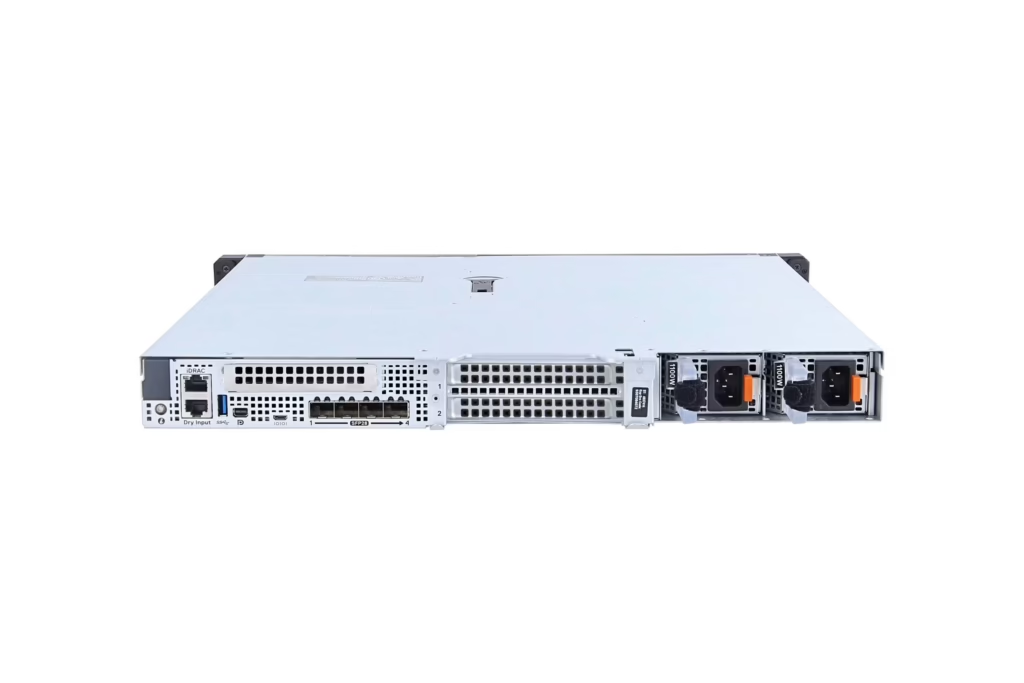
The PowerEdge XR5610 is a Dell edge server platform designed for organizations that need reliable compute power, overall system performance, and scalable edge deployment services. The collection includes single-socket configurations in a compact 1U short-depth rack-mount design. It supports high-density workload traffic while providing dedicated interfaces for network, management, local console, and expansion connections.
The platform combines Dell management systems with custom-built enterprise hardware. This design allows companies to process edge data, execute AI and telecommunications workloads, and offload processing obligations from core data centers. Dell positions the XR series platform for edge computing performance and environmental adaptability.

Key Features of PowerEdge XR5610
Edge Workload and AI Processing
The PowerEdge XR5610 processes workloads at both the physical edge and virtualized network layers. Low-latency edge processing specializes in real-time device control and data filtering. AI acceleration processing enables local inference decisions based on video and operational data.
Environmental Hardening and Protection
Operating in extreme temperatures can consume processing performance. XR5610 servers can withstand harsh thermal environments through ruggedized design. This can reduce physical wear on system components and help manage edge deployments in unconditioned spaces more effectively.
25GbE and Flexible Networking Connectivity
The platform provides four 25GbE SFP+ ports and an optional OCP 3.0 expansion slot. It also consists of a dedicated iDRAC remote management interface. This combination allows groups to attach the equipment to different components in their edge network.
High Availability Support
The equipment includes redundant hot-swappable power supply options. This supports configurations where PowerEdge servers work together for uninterrupted system availability and operational continuity. The platform also helps with hot-swapping of front storage drives and optical transceiver modules in systems configured with dual power supplies.
Front-Panel Access and Management
The XR5610 consists of front-accessed I/O options, status LEDs, and system diagnostic ports on the front chassis. Administrators can use the front panel to view system health, take a look at indicators, and perform basic management tasks.
Capabilities
- Application delivery: The platform manages workloads among remote sensors and centralized servers. It can help distribute processing demands and control data flows.
- Traffic control: PowerEdge can process data at local and cloud boundaries. This allows directors to use policies based entirely on network and telecommunications data.
- vRAN processing: Hardware acceleration enables managing supported cellular network operations without setting the complete processing load on cloud servers.
- Application availability: Organizations can use PowerEdge hardware redundancy and management features to build resilient edge computing environments.
- Performance optimization: Dell’s XR series platform makes use of hardware and software optimizations to improve compute processing. The XR5610 also supports GPU acceleration for specialized workloads.
- Centralized management: PowerEdge uses iDRAC9 and OpenManage to offer control and management across edge server offerings.
Key Specifications
| Feature / Specification | Details |
| Series | PowerEdge XR Series |
| Models | XR5610 |
| Form Factor | 1U short-depth rack-mount chassis |
| Processor | 1 × 4th or 5th Gen Intel Xeon Scalable (up to 32 cores) |
| Memory | Up to 1 TB DDR5 (8 RDIMM slots) |
| Storage | Up to 4 × 2.5-inch SAS/SATA/NVMe SSDs |
| 25GbE Interfaces | 4 × SFP+ LOM |
| Expansion Slots | Up to 2 × PCIe Gen5 slots, 1 × OCP 3.0 slot |
| Management Port | 1 × 1GbE Dedicated iDRAC Port |
| Console Port | 1 × Micro-AB USB / Serial |
| Service Port | 1 × Front USB / Direct iDRAC |
| USB | 2 × USB 3.0 |
| Operating Temperature | -5°C to 55°C (NEBS Level 3) |
| Certifications | MIL-STD-810H, NEBS Level 3 |
Common Use Cases
The PowerEdge XR5610 fits edge computing environments that need controlled workload distribution, continuous availability, and efficient handling of telemetry and operational traffic. Organizations can use it in telecom sites to manage cellular networks, industrial facilities, remote sites, and different critical services. It can also handle AI inference processing and connect with present 10GbE and 25GbE network infrastructure. The precise deployment depends on workload requirements, expansion options, physical layout, and required Dell offerings.
Real-World Deployment Scenarios
- Telecom 5G vRAN Deployments: Distribute processing requests throughout a couple of cell sites and manage traffic from a relevant platform.
- Smart Factory Operations: Manage operational traffic across machines and local servers at some point of everyday and high-demand periods.
- Defense and Field Operations: Apply managed compute control and ruggedized processing for mission-critical edge services.
- Remote Utility Infrastructure: Place the equipment between field devices and central clouds to manage data within a micro-site environment.
- Retail Video Analytics: Improve local data control for customer-facing applications that rely upon multiple camera feeds.
- Business-Critical Edge Workloads: Use PowerEdge compute power and failover abilities to support applications that require steady availability.
Why Choose Netmate for PowerEdge XR5610?
Netmate IT helps agencies in Nepal compare and deploy Dell answers based on their compute, edge, and network requirements. For the PowerEdge XR5610, Netmate can assist groups in selecting the appropriate platform, planning the deployment, integrating the server with current infrastructure, and configuring the required management software services. The aim is to offer a sensible Dell answer that suits the enterprise’s performance, durability, availability, and infrastructure requirements.
Frequently Asked Questions
What is the PowerEdge XR5610?
The PowerEdge XR5610 is a Dell hardware platform for edge computing and workload management. The series features a 1U short-depth rack-mount layout and provides 25GbE and high-density expansion interfaces.
What is the difference between standard rack servers and the XR5610?
Standard servers and the XR5610 share core compute architecture; however, their chassis design and environmental ratings differ. The XR5610 supports operating temperatures from -5°C to 55°C and MIL-STD-810H durability, while standard servers operate in climate-controlled environments. Both provide high throughput and enterprise-grade system capabilities.
How much memory does the PowerEdge XR5610 support?
The XR5610 supports up to 1 TB of DDR5 memory across 8 RDIMM slots in Dell’s modern platform specs. Actual performance relies upon the memory modules installed, workload profile, configuration, and operating conditions.
What network interfaces does the PowerEdge XR5610 have?
The platform presents four 25GbE SFP+ ports and an OCP 3.0 slot. It additionally includes a dedicated iDRAC management port, serial console connection, USB 3.0 ports, and front service interfaces.
Who should use the PowerEdge XR5610?
The platform fits organizations that need dedicated edge computing hardware for local data processing, high system availability, and performance. It can match industrial environments, telecom locations, and other sites that want a compact 1U short-depth device with high-speed connectivity.
Reviews
There are no reviews yet.