

Description
PowerEdge XR4510c
The PowerEdge XR4510c is a rugged, high-density server sled engineered specifically for edge computing environments that require compact footprints, high compute density, and operational resiliency. Designed as a 1U, single-width compute node, the XR4510c fits into specialized Dell multi-node enclosures like the XR4000r and XR4000z chassis. It enables organizations to scale compute capacity at remote edge sites, branch locations, and industrial environments without consuming critical rack space.
The sled pairs energy-efficient Intel processors with dense memory and NVMe storage options. This modular architecture allows enterprises to consolidate edge workloads, run multi-node virtual clusters, and process data directly where it is generated. Dell positions the XR4510c platform for edge analytics, virtualization, and distributed deployment models across unpredictable operational environments.
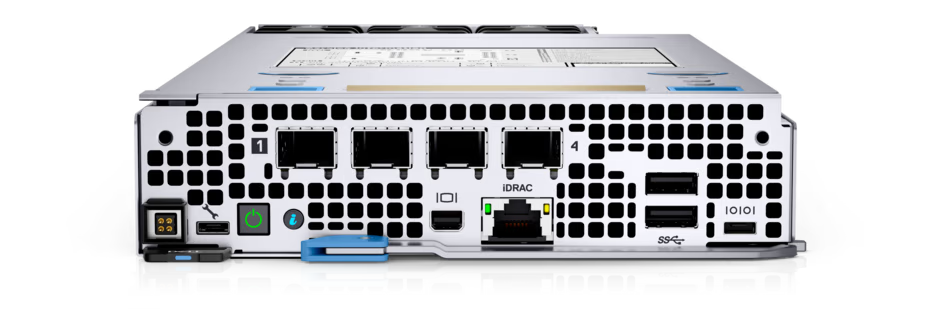
Key Features of PowerEdge XR4510c
Dense Multi-Node Modular Architecture
The PowerEdge XR4510c operates inside Dell XR4000 chassis configurations. The 2U XR4000r chassis holds up to four independent XR4510c compute sleds, while the compact XR4000z chassis holds up to two sleds. This multi-node design allows administrators to service or swap individual nodes using a “pull-replace-repair” approach without interrupting adjacent running servers.
Intel Xeon D Edge Processing
Equipped with a 3rd Gen Intel Xeon D Scalable processor offering up to 20 cores, the XR4510c balances raw parallel processing power with low thermal design power (TDP). This compute profile handles demanding workloads at remote edges—such as local data aggregation, containerized applications, and edge telemetry—without needing standard high-power data center cooling infrastructure.
Optimized NVMe Storage and Boot Subsystem
Storage latency is minimized through direct-attached M.2 NVMe SSDs. The compute node accommodates four internal M.2 NVMe drives for high-throughput primary storage. Separate hardware-RAID BOSS-N1 modules manage system boot functions using dual M.2 NVMe SSDs, isolating OS recovery operations from main application data storage.
Flexible Airflow and Network I/O
The XR4510c accommodates severe hardware room limitations with flexible airflow choices: Normal Airflow (NAF) for traditional setups and Reverse Airflow (RAF) for front-accessible/cold-aisle servicing. Networking I/O features either four 10GbE or four 25GbE SFP ports directly driven from the processor, alongside dedicated iDRAC management ports.
In-Chassis Nano Witness Server Compatibility
When combined with Dell’s optional XR4000w Nano Witness Server node inside the same chassis, the XR4510c facilitates fully resilient, self-contained two-node VMware vSAN clusters. This eliminates the need for an offsite external witness server, simplifying hyperconverged infrastructure (HCI) deployment at remote locations.
Silicon Root of Trust and Hardware Security
Security controls built directly into the sled chassis prevent unauthorized tampering at unattended edge sites. Features include cryptographically signed firmware updates, Secure Boot, System Lockdown via iDRAC9, hardware TPM 2.0 options, and a Silicon Root of Trust to maintain chain-of-custody security from cold boot to active runtime.
Capabilities
- Edge Infrastructure Consolidation: The sled pools dense compute cores, high memory, and fast NVMe storage into compact chassis formats to reduce physical footprint at branch offices or factory floors.
- Hyperconverged Deployment: Pairs easily with hypervisors like VMware ESXi and Microsoft Hyper-V to support virtual machines and 2-node vSAN clusters directly on site.
- Low-Latency Data Processing: Processes incoming IoT, telecom, or transactional data at the local edge, eliminating expensive bandwith backhauling to centralized data centers.
- Flexible Edge Mounting: Operates inside rackable or wall-mountable/stackable chassis configurations designed for space-restricted non-datacenter settings.
- Continuous System Health Monitoring: Utilizes embedded iDRAC9 hardware management and OpenManage software integrations to remotely maintain and patch dispersed hardware nodes.
- Harsh-Environment Reliability: Continues functioning across extreme temperature fluctuations, dusty environments, and vibration-prone installations.
Key Specifications
| Feature / Specification | Details |
| Series | Dell PowerEdge XR Series |
| Model | PowerEdge XR4510c Compute Sled |
| Form Factor | 1U single-width compute sled (Half-width) |
| Enclosure Compatibility | PowerEdge XR4000r (Rackable) and XR4000z (Stackable/Wall-mount) |
| Processor | 1 × 3rd Gen Intel Xeon D Scalable processor (up to 20 cores, up to 120W TDP) |
| Memory | 4 × DDR4 DIMM slots; up to 512 GB LRDIMM / 256 GB RDIMM (up to 3200 MT/s) |
| Storage | Up to 4 × M.2 NVMe SSDs (2280 / 22110) on M.2 riser card |
| Boot Subsystem | Optional BOSS-N1 with 2 × M.2 NVMe SSDs (480 GB or 960 GB) |
| Network Interfaces | 4 × 10GbE SFP (max 50 Gb) OR 4 × 25GbE SFP (max 100 Gb) |
| Front Ports | 1 × iDRAC Direct (Micro-AB USB), 2 × USB 3.0, 1 × Serial, 1 × Mini-DisplayPort, 1 × Dedicated iDRAC9 RJ45 |
| Remote Management | iDRAC9 with Lifecycle Controller, OpenManage Enterprise integration |
| Operating Temperature | Ruggedized operating range from -5°C to 55°C (23°F to 131°F) |
Common Use Cases
The PowerEdge XR4510c fits decentralized operational sites requiring server-grade compute capability in non-standard physical conditions. Organizations deploy this sled across remote branches, retail outlets, industrial floors, telecommunications sites, and defense environments. The precise deployment varies depending on network bandwidth requirements, hyperconverged software configurations, physical mounting needs, and environmental constraints.
Real-World Deployment Scenarios
- Retail Point-of-Sale & Store Automation: Runs in-store inventory control systems, virtual desktop infrastructure (VDI), and local POS databases inside a compact wall-mounted chassis.
- Telecommunications & Multi-Access Edge Computing (MEC): Handles local traffic management, 5G virtualized network functions, and service routing at cell sites or distributed access points.
- Industrial Manufacturing Floors: Aggregates machine telematics, monitors IoT telemetry, and executes real-time process control in dust-prone environments.
- Remote Healthcare & Branch Offices: Hosts local application servers, medical imaging caches, and virtual machine workloads without requiring a dedicated server room.
- Video Surveillance & Physical Security: Serves as a localized recording and management node for multi-camera physical security setups at isolated facilities.
- Edge Hyperconverged Infrastructure (vSAN): Operates as a resilient two-node compute cluster using an in-chassis witness node for remote site high availability.
Why Choose Netmate for PowerEdge XR4510c?
Netmate IT assists organizations in Nepal with evaluating, procuring, and architecting Dell edge server environments customized to local infrastructure demands. For the PowerEdge XR4510c, Netmate helps teams select the appropriate chassis configuration, compute density, network interfaces, and storage options. From initial hardware sizing to remote iDRAC setup and integration with existing networks, Netmate delivers practical Dell server solutions designed for reliability, operational longevity, and remote management efficiency.
Frequently Asked Questions
What is the PowerEdge XR4510c?
The PowerEdge XR4510c is a ruggedized 1U, single-width compute sled engineered by Dell for edge environments. It houses an Intel Xeon D processor, up to 512 GB of RAM, and M.2 NVMe storage within modular multi-node enclosures like the XR4000r and XR4000z.
What is the difference between the XR4510c and XR4520c sleds?
The XR4510c is a 1U single-width compute sled focused on dense server compute cores, memory, and M.2 NVMe storage. The XR4520c is a 2U single-width compute sled that provides additional expansion room for full-height PCIe add-in cards and dedicated GPUs (such as NVIDIA A2 or A30).
What network interfaces are available on the XR4510c?
The XR4510c sled offers integrated networking options driven directly by the processor, supporting either 4 × 10GbE SFP or 4 × 25GbE SFP interfaces, along with a dedicated RJ45 iDRAC management port.
How does the XR4510c handle OS booting and local storage?
Primary application storage is handled by up to 4 × internal M.2 NVMe SSDs. OS boot functions can be isolated onto an optional BOSS-N1 storage controller that uses dual mirrored M.2 NVMe SSDs to maintain hardware-level OS redundancy.
Can the PowerEdge XR4510c operate outside a standard data center?
Yes. The XR4510c and its accompanying XR4000 series chassis are designed for rugged edge deployments. They support flexible rackable or wall-mountable chassis formats, extended operating temperatures (-5°C to 55°C), reverse airflow configurations, and intelligent dust-filtered bezels.
Reviews
There are no reviews yet.